

Menu
Turning Timesheets Into Engagement - A Points-Based Rewards System for Staffing Agencies
The Problem
Late timesheets are a persistent headache for staffing agencies. When employees delay submissions, payroll gets delayed, billing cycles slip, and administrative staff spend hours chasing people down. For one mid-sized employment agency, the pattern was familiar: roughly 30% of timesheets arrived late each week, creating a cascade of manual follow-ups and reconciliation work. The agency also struggled with stale employee contact information. Phone numbers and addresses in their workforce management system were often months out of date, making it difficult to reach employees when issues arose. Traditional approaches - reminder emails, manager escalation, policy warnings - had diminishing returns. The agency needed a different lever.
The Solution
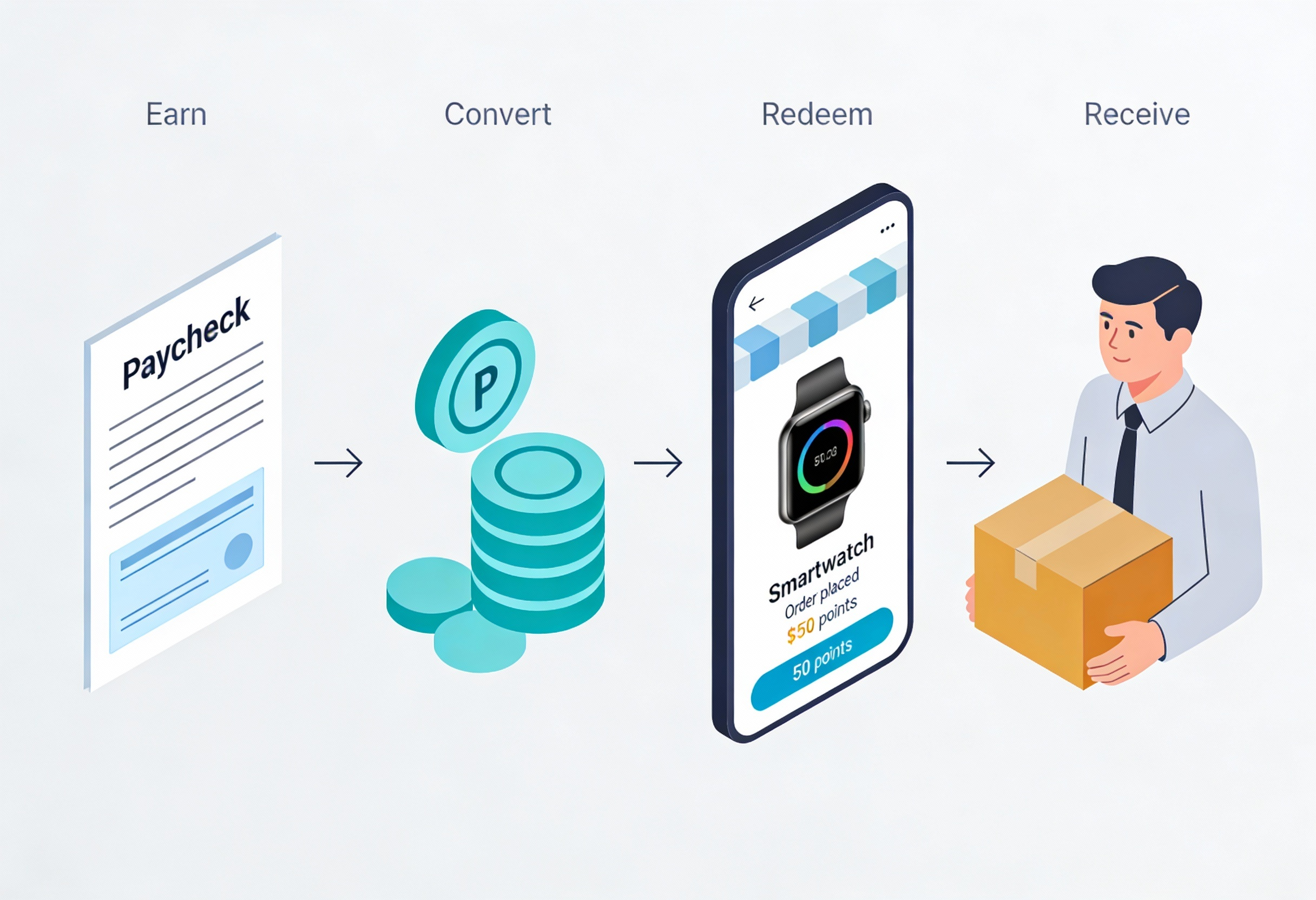
We built a rewards platform that converts submitted timesheet hours into redeemable points. Employees earn points automatically when their timesheets are processed, and those points become currency in a private e-commerce store stocked with merchandise, gift cards, and other items.
The store runs entirely on points-no cash transactions. The agency manages inventory, pricing, and fulfillment. Employees log in using their phone number, which is pulled from their profile in the workforce management system. If the phone number is wrong or missing, they can't access the store-a simple but effective nudge to keep contact information current.
"We stopped asking people to submit timesheets on time. We started rewarding them when they did."
Architecture
The system is built on a standard e-commerce framework. We extended it with a custom rewards layer:
- Points engine: Uses a gamification package to award points when timesheets are processed. Points are tied to the customer (employee) record.
- Timesheet sync: A weekly scheduled job connects to the agency's workforce management API, pulls new timesheets, and queues them for processing.
- Employee metadata refresh: Each sync also updates employee contact information-phone, email, address-so the store always reflects current data.
- Phone-based authentication: Employees authenticate with their phone number, validated against the synced metadata.
The e-commerce side is standard: product catalog, cart, checkout, order management, shipping. The only difference is the currency-points instead of dollars.
Challenges
1. Keeping employee data in sync without manual intervention
Employee records live in a third-party workforce management system. We needed the store to reflect current contact information without requiring duplicate data entry.
Approach: The weekly timesheet sync also refreshes employee metadata. If an employee's phone number changes in the source system, it updates in the store automatically. This keeps authentication working and removes a maintenance burden.
Why it worked: Single source of truth. The agency manages employee data in one place, and the rewards system follows.
2. Handling missing or delayed timesheet data
API calls fail. Data arrives late. Employees submit corrections. The points engine needed to handle these gracefully without double-crediting or missing legitimate submissions.
Approach: We built a reconciliation command that runs weekly to detect and fix discrepancies-timesheets that were processed but didn't generate points, or points that were awarded incorrectly. It logs every adjustment for audit purposes.
"The reconciliation job runs weekly and we haven't had to touch it in months."
Why it worked: Automation with visibility. The scheduled job handles edge cases quietly, and the logs provide a paper trail when questions arise.
3. Encouraging adoption without forcing it
A rewards program only works if people use it. We couldn't mandate participation, and we didn't want to create resentment.
Approach: The barrier to entry is low, employees just need a valid phone number on file. Points accumulate automatically. In addition to organic adoption, the agency introduced the system directly in the same communications employees already paid attention to: timesheet emails and mailers. Each payroll cycle included a brief explanation of how points were earned and what they could be redeemed for.
The store itself remained optional but visible, reinforcing the incentive without pressure.
Why it worked: Familiar touchpoints, minimal friction. Employees were introduced to the system at the exact moment timesheets mattered, and participation required no new behavior beyond what they were already doing.
4. Managing a store with non-currency transactions
Standard e-commerce assumes money. We needed checkout, invoicing, and order management to work entirely with points instead.
Approach: We implemented points as the system’s native currency, not just a UI abstraction. All internal pricing, balances, and transactions are denominated in points. The checkout flow deducts points directly, order records store point values internally, and refunds credit points back to the customer account.
There is no parallel dollar representation. Points are the only unit of value throughout the system.
Why it worked: By treating points as first-class currency, we avoided edge cases and inconsistencies. Inventory management, order history, refunds, and reporting all behave predictably without currency conversions or special casing.
"It's a real store with real inventory. The only thing that's different is what you pay with."
Outcomes
Results are directional - the agency hasn't shared exact figures - but the observed improvements include:
- Reduction in late timesheets: Fewer follow-up calls from payroll staff. The incentive shifted behavior without policy changes.
- Improved data quality: Phone numbers and contact info are more current because employees have a reason to keep them updated.
- Lower administrative overhead: The sync and reconciliation jobs run unattended. Manual data entry and timesheet chasing have decreased.
- Employee engagement: The store sees regular orders. Employees talk about available items and point balances.
The agency reports that the program "pays for itself" in reduced administrative time, though they haven't quantified the hours saved.
What We'd Improve Next
- Real-time points: Currently, points are awarded on a weekly batch cycle. Moving to event-driven processing would let employees see points immediately after timesheet submission.
- Tiered rewards: Bonus points for consecutive on-time submissions, or for employees who maintain complete profile data.
- Mobile optimization: Rather than building a dedicated app, we’d lean into modern frontend frameworks to optimize images, layouts, and interactions for mobile-first usage. As most employees access the store from their phones, performance and clarity matter more than platform-specific features. On the management side, a lightweight admin interface focused on the most common tasks-inventory updates, order status, and fulfillment-would make on-the-go administration significantly easier.
- Reporting dashboard: Better visibility for agency managers into program participation, redemption rates, and points liability.
If You Have a Similar Workflow
Staffing agencies, field service companies, and any organization with distributed workers and recurring compliance tasks face variations of this problem. If you're spending time chasing timesheets, expense reports, or certifications-and traditional reminders aren't moving the needle-a rewards-based approach might be worth exploring. The technical lift is modest if you already have a system of record for the data you want to incentivize. The harder part is designing incentives that feel fair and valuable to the people you're trying to reach.